
Search Schleicher Civil Dockets
No verified county-hosted public viewer exists for Schleicher County civil cases. Start with the combined County and District Clerk. Give the office the court, cause number if known, case type, date range, and exact docket entry or document needed. Do not send private identifiers that are not needed to locate the file.
re:SearchTX is a supplemental state route. Its observed interface requires registration or sign-in, and access may vary by role and document. A blank result is not proof that no case exists.
- Identify the 51st District Court, County Court, or Justice Court as custodian.
- Gather party names, the case category, filing period, and cause number.
- Check re:SearchTX for a possible electronic index.
- Call, email, mail, fax, or visit the clerk if the online search fails.
- Specify inspection, a plain copy, or a certified copy.
Schleicher Civil Court Routes
The court matters more than the town name. District civil and family cases run through the 51st District Court. The constitutional Schleicher County Court handles supported county-level categories, including probate. Justice Court is the local route for small claims, debt claims, and evictions. Its official resources provide forms, but a form download does not prove that a case was filed.
| Court | Civil work | Access |
|---|---|---|
| 51st District Court | District civil and family | Combined clerk |
| County Court | County civil and probate | Combined clerk |
| Justice Court | Small claims, debt, eviction | JP office |
Federal civil cases follow a separate path through PACER and the Northern District of Texas.
A Schleicher district cause, Schleicher county cause, and Schleicher justice cause use different custodians. Naming the Schleicher court helps the Schleicher clerk route the request.
The combined office title can mislead. One counter answers county and district questions, but each cause still belongs to a specific court. Name that court in every request. The 51st District Court also uses administrative coordinators in San Angelo. A setting question may go to a coordinator while inspection and copy requests remain with the Schleicher clerk in Eldorado.
What Schleicher Civil Dockets Show
A docket is the running index of activity, not always the full file. The research exposed no public Schleicher sample docket, so these fields are a request checklist rather than a claim about the layout of a local screen.
| Cause number | The court identifier to provide exactly when known. |
|---|---|
| Parties | Plaintiff, defendant, petitioner, respondent, or other parties. |
| Filings | Petitions, answers, exhibits, motions, and accepted dates. |
| Settings | Scheduled event, date, court, and setting type. |
| Disposition | A dismissal, judgment, order, or other result. |
A filing date, setting date, and disposition date answer different questions. The index may show an event without the filed PDF or signed order. Ask separately for the petition, motion, judgment, or complete nonsealed file. Service, appeal, costs, and writ status may also need direct confirmation, especially in an eviction matter.
The Schleicher cause number links each Schleicher filing to its Schleicher case. A Schleicher setting and Schleicher judgment remain distinct entries.
Schleicher E-Filing Is Not Access
eFileTexas accepts filings. It is not a general public docket viewer. The active-courts table marks Schleicher civil filing as mandatory and search as limited. Limited search does not promise a complete archive for the public.
Key distinction: electronic filing, clerk custody, and public access are three separate functions.
Older paper records may not appear through the same route. Ask the clerk how the specific case is stored.
Schleicher e-filing sends a Schleicher filing to a Schleicher court. It does not by itself open the Schleicher docket or Schleicher document.
Schleicher Limited Search Status
The official active-courts source records Schleicher's mandatory filing and limited search status.
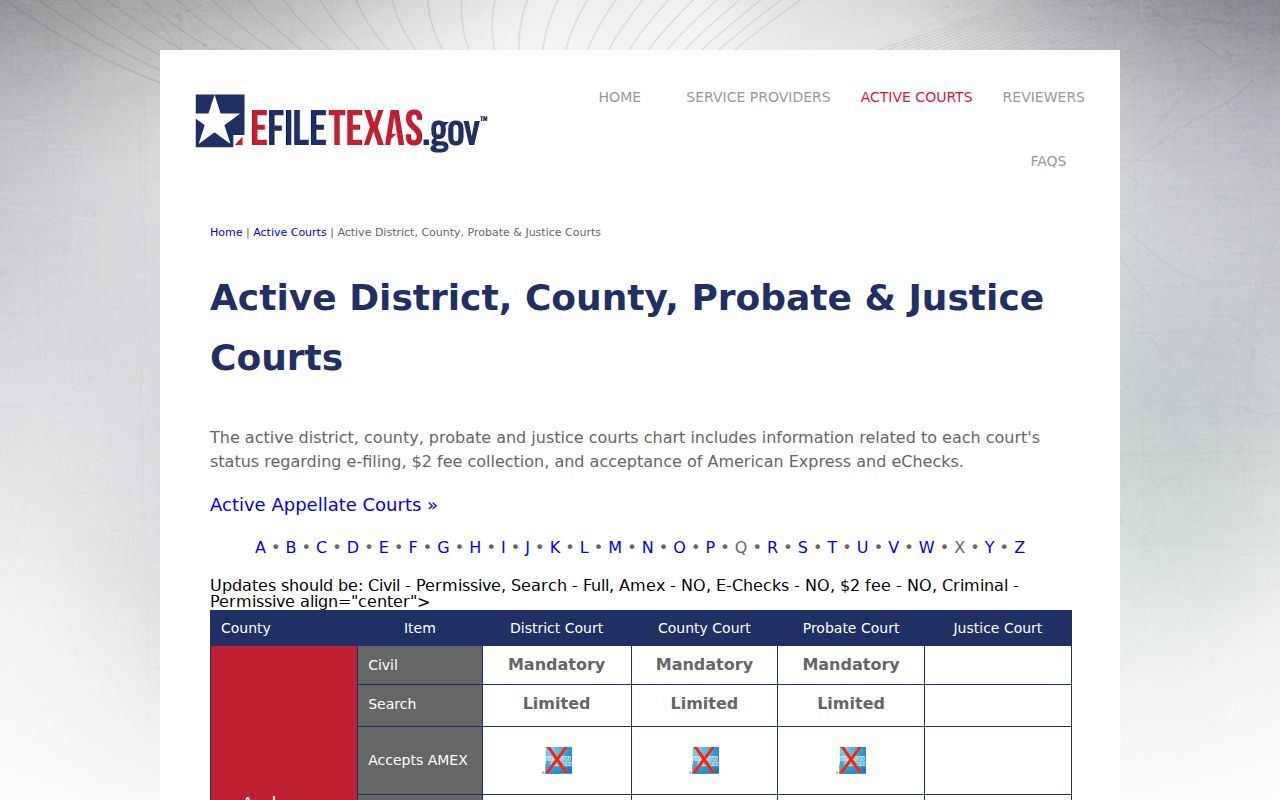
The capture shows why an accepted electronic filing does not guarantee a complete public civil docket. Historical paper files and documents outside a user's access may still require the clerk.
Schleicher Civil Docket Case Types
Schleicher County civil work spans several courts. The combined clerk reports support for district civil and family files and county civil, probate, juvenile, and mental-health categories. Some of those files have access limits.
- District civil disputes and family proceedings
- County civil and probate matters
- Justice Court small claims and debt claims
- Eviction cases and later writ activity
- Juvenile or mental-health matters when access law permits
Probate differs from an ordinary civil dispute. Juvenile and mental-health categories are more sensitive still. Support in a case-management system does not establish public access. Ask which index or redacted record can be released, and let the clerk apply the controlling rule or order.
A Schleicher probate file, Schleicher family file, and Schleicher juvenile file can carry different limits. The Schleicher clerk applies the rule to each Schleicher request.
Schleicher Civil Copy Choices
A docket inspection, plain copy, and certified copy are distinct requests. The posted schedule is a starting point, but the clerk should confirm the rate for a court file.
| Item | Posted amount |
|---|---|
| Copy | $1.00 per page |
| Certified copy | $1.00 per page |
| Certification | $5.00 |
Government Code Chapter 51 has district-clerk provisions too. Ask for an estimate before a large order.
Build a Precise Schleicher Request
State whether the cause is district civil, county civil, probate, Justice Court debt, small claims, or eviction. Add the cause number, party names, filing range, and exact item wanted. Useful item names include docket sheet, petition, answer, motion, order, judgment, costs, or complete nonsealed file.
Choose inspection, electronic delivery, paper copy, or certification. Ask for a fee estimate before a large order. If no cause number is known, provide enough search facts and say so. Chapter 51 materials list a search fee in some district-clerk circumstances, so confirm the current charge first.
The Schleicher court, Schleicher cause number, Schleicher date range, Schleicher document type, and Schleicher delivery choice make the request precise.
Schleicher Civil Docket Settings
For a district civil or family setting, the District Judge page names a civil coordinator. Setting emails should include the court and county, cause number, case style, requested setting, and all other counsel or self-represented parties.
The county public calendar is an administrative and notice tool, not a verified case docket. Its CC category shows no cause number, party, judge, courtroom, or setting type. Confirm each hearing with the court, coordinator, or clerk and consult the Schleicher County court calendar instructions.
If a Schleicher Case Is Missing
Check the court, spelling, filing range, and any partial cause number. Then contact the combined clerk at (325) 853-2833 or scclerk@co.schleicher.tx.us. Mail, fax, and the courthouse counter are also available.
Ask whether the file is paper-only, newly accepted, sealed, confidential, juvenile, or held elsewhere. Justice Court can be reached at (325) 853-2766. A general county contact form is not a document portal.
A missing Schleicher result may reflect the Schleicher court choice, Schleicher spelling, Schleicher date range, or Schleicher access limit.
Note: Ask for a redacted public copy when the full record cannot be released.
Schleicher Clerk Access Channels
Schleicher phone, Schleicher fax, Schleicher email, Schleicher mail, and Schleicher counter access all reach the Schleicher clerk for a Schleicher docket, Schleicher filing, Schleicher order, Schleicher judgment, Schleicher copy, or Schleicher certification.
The clerk lists phone, fax, email, mail, and in-person access. Mail goes to P.O. Drawer 580, Eldorado, Texas 76936-0580. The public counter is at 2 South Divide Street. Posted hours are weekdays from 9 a.m. to noon and 1 p.m. to 5 p.m. Verify them before travel.
The general county form has no cause-number field, payment step, upload control, or record-order process. Email or phone is clearer for a docket question. A mailed request should include return contact details and request an estimate. re:SearchTX remains an added route, not a substitute for local channels.
Small Claims Docket Checks
The Justice Court resources include small-claims, debt-claim, eviction, petition, answer, inability-to-pay, and federal military-status forms. These links explain filing tools, not the status of a particular case. Confirm that a petition was accepted and obtain its cause number from the JP office. For an eviction, ask separately about judgment, appeal, and any writ. For a debt claim, identify the exact pleading or order needed. A person who cannot find a Justice Court matter through county or state tools should call the JP rather than assume the matter was never filed.
The JP is a separate custodian from the combined County and District Clerk. Directing a request to the right office is the fastest first step.
A Schleicher petition, Schleicher answer, Schleicher judgment, Schleicher appeal, and Schleicher writ mark separate case events.
Public Schleicher Civil Docket Access
Civil records are generally open unless a statute, rule, or order restricts them. Texas courts are not treated like ordinary executive agencies under the Texas Public Information Act. The Judicial Branch policy directs case-record requests to the court or clerk under court rules and other law.
Rule 76a governs civil-record sealing. Family, juvenile, mental-health, protective, and sensitive personal information may have added limits.
Rule 12 generally opens covered judicial records during business hours, but it does not override laws that control a case file. It also does not require a custodian to create a record or retain one for a special period. If access is denied, ask which authority controls and whether a redacted version can be supplied.
Key rules:
Texas Rule of Civil Procedure 76a controls sealed civil court records.
Rule 12 policy explains access to judicial records and its exclusions.
Government Code Chapter 51 addresses clerk searches and copies.